

The 7th International Conference on Frontier Information and Computer Technologies (ICFTIC 2025) was held from December 5 to 7, 2025, on the campus of China University of Petroleum (East China). The conference was jointly organized by China University of Petroleum (East China), Shandong Artificial Intelligence Society, and Shandong Computer Society, and co-hosted by the Qingdao Software College and the School of Computer Science and Technology of China University of Petroleum (East China), the Key Laboratory of Intelligent Oil and Gas Industrial Software in Shandong Province, the Qingdao Software Industry Industry-Education Alliance, and the AEIC Academic Exchange Information Center. IEEE SMC and the Qingdao Branch of the China Computer Federation supported the event.

Opening Ceremony
On the morning of December 6, Professor Zhang Junsan, Vice Dean of Qingdao Software College and School of Computer Science and Technology of China University of Petroleum (East China), presided over the opening ceremony. Professor Wu Chunlei, Party Secretary of the School, attended and delivered a welcome speech. Secretary Wu warmly welcomed the experts and scholars who came from afar and emphasized the importance of international academic exchanges in promoting technological innovation and industrial upgrading within the rapidly developing fields of information and computer technology.

Professor Zhang Junsan presiding over the meeting
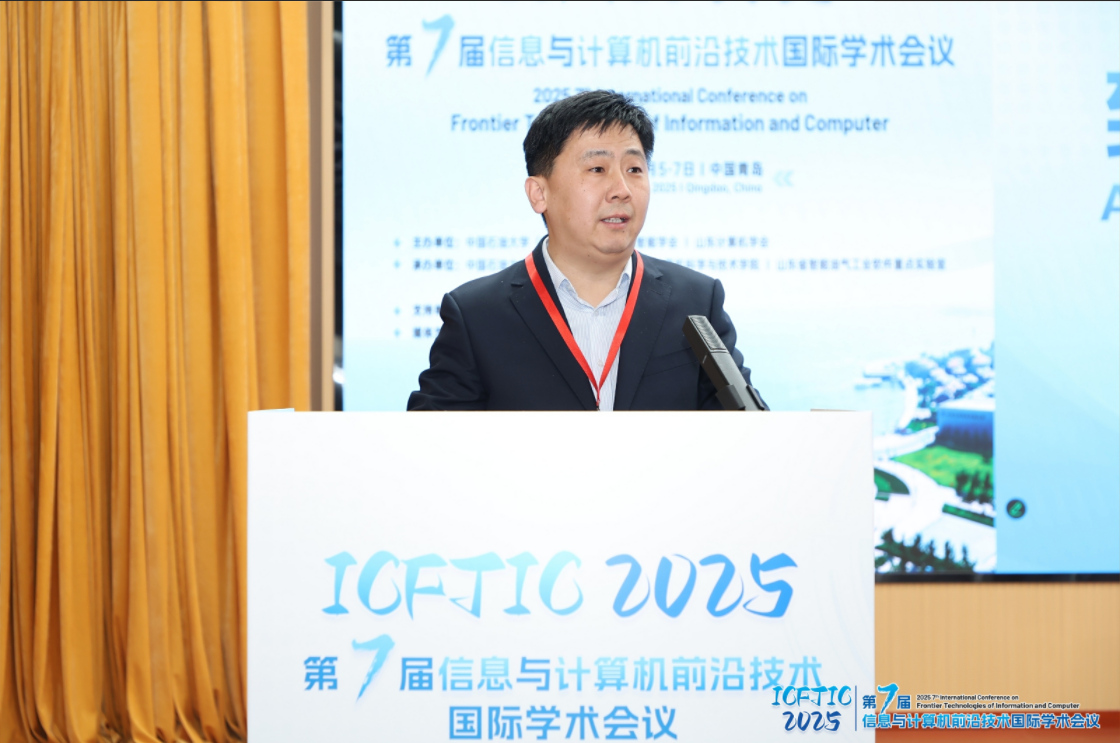
Professor Wu Chunlei delivering a speech
The conference also specially invited Professor Zhu Haibin (IEEE/AAIA Fellow), TPC Chair and distinguished scholar from Nipissing University, Canada, to give an online address. Professor Zhu briefly reviewed the overall conference situation, expressed gratitude to the organizers for their meticulous preparation and strong efforts to ensure the smooth hosting of the conference, and extended heartfelt thanks to all participants for their hard work and significant contributions.
 Professor Zhu Haibin delivering a speech
Keynote Speeches
The keynote sessions formed the core of the conference, with four renowned domestic and international scholars sharing their latest research achievements.
Professor Jiang Hongbo, Academician of the European Academy of Sciences and Fellow of IET/BCS/AAIA from Hunan University, gave a presentation titled “From Agrarian Civilization to the New Industrial Revolution: Key Technologies and Prospects for Industrial Digital Transformation in the AI Era.” He reviewed, from a historical perspective, the revolutionary impact of technological revolutions on social production methods, focusing on how key technologies such as artificial intelligence, the Internet of Things, and big data drive current industrial digital transformation and foreseeing the future development directions of intelligent manufacturing.

Professor Jiang Hongbo’s keynote report
Professor Li Yun, IEEE Fellow and member of the Advanced Research Institute at the University of Electronic Science and Technology of China (Shenzhen), focused on “AI Models for Engineering and Embodied Intelligence.” He deeply explored the application of AI in complex engineering systems and research progress in embodied intelligence, an emerging field. Through multiple case studies, he demonstrated how AI models understand and adapt to the physical world, achieving more intelligent machine behavior.
 Professor Li Yun’s keynote report
Professor Zhu Zuqing, IEEE Fellow from the University of Science and Technology of China, presented “Accelerating Collective Communications with Mutual Benefits of Optical Rackless DC and In-Network Computing.” Starting from the infrastructure level, he discussed how a novel architecture integrating optical networks and computing could overcome communication bottlenecks in large-scale distributed computing, providing innovative solutions for next-generation data centers and computing power networks.
 Professor Zhu Zuqing’s keynote report
Professor Tan Ying, inventor of the Fireworks Algorithm and professor at Peking University, delivered a talk titled “Latest Progress of Fireworks Algorithm (FWA) & Its Applications.” He shared the latest developments and applications of the Fireworks Algorithm, a representative swarm intelligence algorithm noted for its unique explosion search mechanism and excellent performance in optimization problems. Professor Tan systematically introduced the algorithm’s theoretical basis, improvement directions, and successful applications in engineering, economics, and other fields.
 Professor Tan Ying’s keynote report
Smart Industrial Software Forum
In the afternoon, the conference entered parallel sessions. The Smart Industrial Software Forum was held at Yifu Auditorium, with five experts conducting in-depth discussions around this theme.
Professor Cai Hongming from Shanghai Jiao Tong University explained AI-driven industrial software construction technologies and practices. Associate Professor Ji Zhe from Northwestern Polytechnical University presented research on high-performance computational fluid dynamics software for complex flow problems. Professors Zhang Weishan and Associate Professor Dong Yukun from China University of Petroleum (East China) reported respectively on knowledge mining for logging integrating large and small models and embodied intelligence implementations, and low-code development methods oriented towards complex software requirements. Professor Lu Xiaoping from the Kaos Industrial Intelligence Research Institute shared practical experiences in upgrading industrial internet platforms empowered by artificial intelligence. The forum concluded with a graduate student session, providing a platform for young scholars to showcase and exchange their work.
 Smart Industrial Software Forum
Invited and Oral Presentations
Simultaneously, an invited and oral presentations session took place in the Yifu Conference Room on the first floor, full of exciting content.
Professor Liu Hongzhi from Peking University reported on trends in adaptive information fusion prediction. Associate Professors Ata Jahangir Moshayedi from Jiangxi University of Science and Technology and Azhar Imran Mudassir from Beijing University of Technology focused respectively on machine learning applications in respiratory parameter estimation and computational intelligence applications in healthcare.
The oral sessions gathered nine young scholars from various universities and research institutes. Their research covered advanced topics including optical fiber sensing event classification, efficient sequence mining, machine learning prediction of calcium carbonate induction time, intelligent monitoring of electrical facilities safety, lithology recognition and classification, robotic arm path planning, spacecraft component segmentation, autonomous drone safety systems, and lossless compression of pulse video streams. These presentations demonstrated deep applications and innovative breakthroughs of information and computer technologies in vertical industries such as energy, geology, aerospace, and healthcare.
 Invited presentations
Online and Offline Integration
To facilitate participation of scholars unable to attend in person, the conference specially set up an online venue synchronized via the Zoom platform. Online presentations covered themes including intelligent computing, image processing, and IoT security, realizing a new model of integrated offline and online conference.
Awards and Closing Dinner
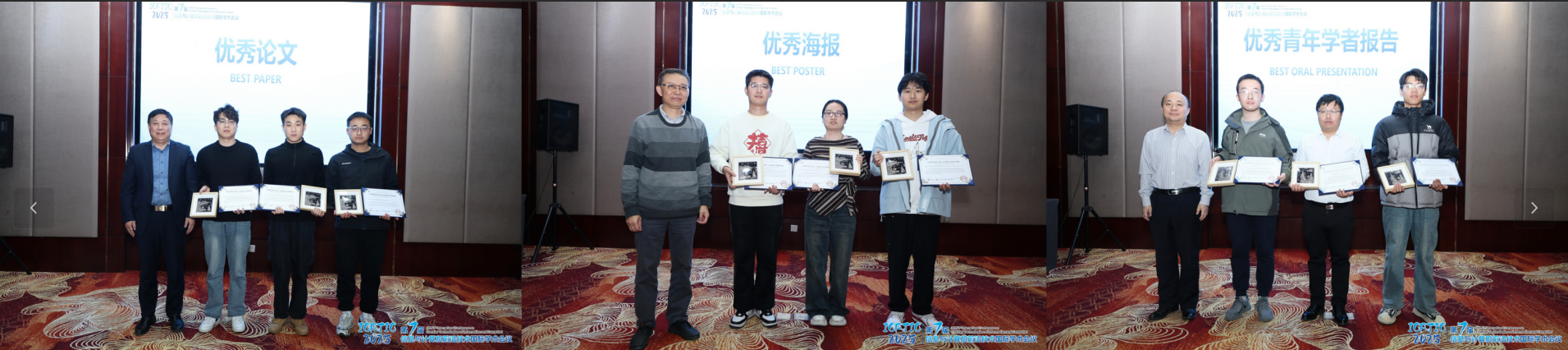
The conference dinner was held that evening at the Howard Johnson Kangda Hotel in Qingdao. Alongside academic exchanges, attendees also experienced the local cultural characteristics of Qingdao. A brief awards ceremony was held during the banquet to recognize outstanding young scholars who presented remarkable research achievements at the conference.
Awards ceremony scene